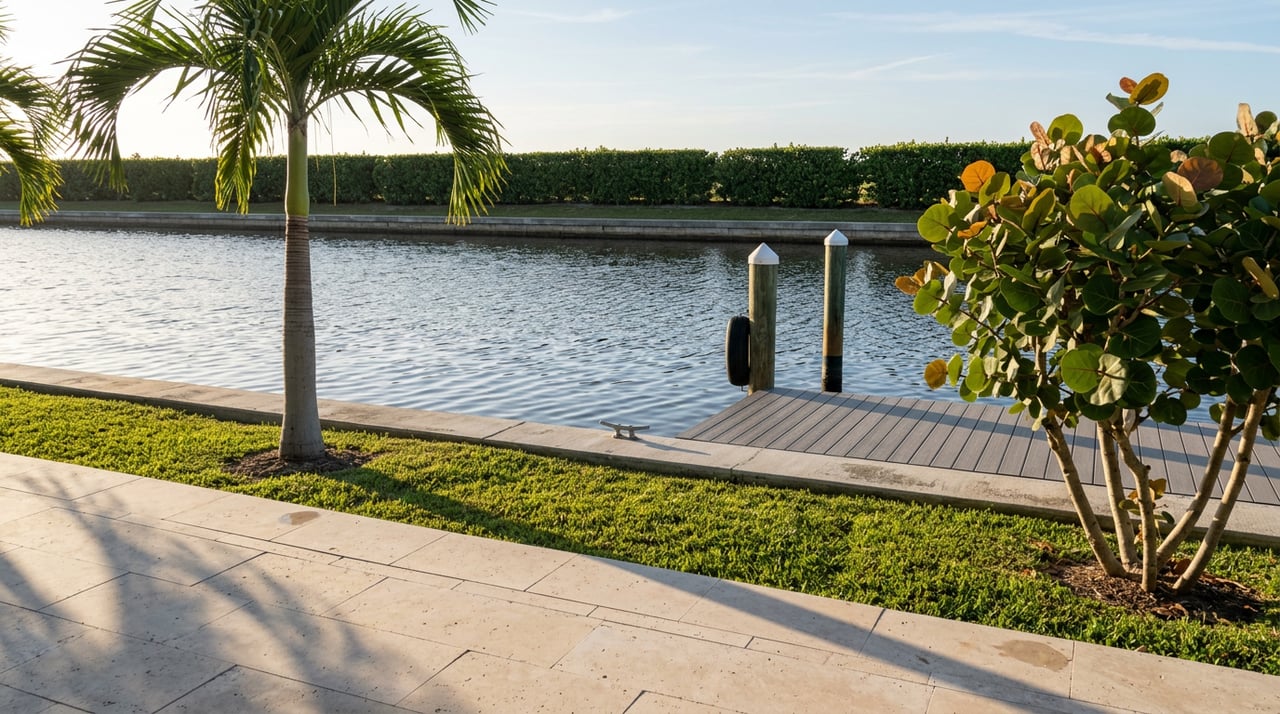
Lighthouse Point Seawall Rules Sellers Need to Know
September 3, 2026
September 3, 2026
A homeowner on one of the Venetian Isles canals calls a marine contractor for a straightforward job: patch eighteen feet of crumbling cap near the dock, maybe recoat a few pilings. The estimate comes back and it isn't for eighteen feet. It's for the whole wall, ninety feet of concrete, permitted and inspected top to bottom.
Nothing about the original request changed. What changed is that Broward County code also sets requirements that can apply when a seawall is repaired, independent of the year on the calendar.
Ask most waterfront owners in this city what governs their seawall and they'll mention 2035. That's the number that shows up in press releases and contractor mailers: seawalls need to reach 4.0 feet NAVD88 by January 1, 2035, and 5.0 feet by 2050, under Broward County's Policy 2.21.7 and Chapter 39, Article XXV of the county code. It's real, and it applies here. But treating 2035 as the trigger date is the mistake. The trigger isn't a date at all.
Under the county's model ordinance, a seawall gets pulled into full compliance the moment one of three things happens: it's newly built, it's cited by the municipality for allowing tidal water to pass onto neighboring property, or it undergoes what the code calls a substantial repair. That last category is the one that catches people. A repair counts as substantial if it touches more than half the wall's length or changes the elevation along more than half of it. Cross that threshold and the entire structure, not just the section you meant to fix, has to come up to the current minimum elevation before final inspection.
A National Law Review press release quoted a marine contractor who works this exact rule across Broward and Palm Beach counties earlier this year: most waterfront owners don't realize the deadline that matters isn't 2035, it's the day they decide to fix more than half their wall.
If cited instead of choosing the repair voluntarily, an owner gets sixty days to show progress and a full year to design, permit, and finish the work. Either path, voluntary or cited, still has to meet the current NAVD88 minimum.
Here's the part that gets lost when people quote the county standard as if it's the only one in play. Lighthouse Point adopted its own seawall ordinance in 2015, five years before Broward County's regional policy existed. City code section 42-381 already set a citywide cap elevation of 4.0 feet NAVD88, with a grandfather provision: a seawall built higher than the legacy threshold could stay in place without full reconstruction if a licensed structural engineer certified it sound. If an existing wall didn't meet that bar, or if it needed to be removed and rebuilt, it had to be reconstructed to the current requirement.
That means two rulebooks now sit on top of the same wall. The city's own code sets a floor. The county's regional standard, phased in through 2035 and 2050, sets separate, later minimums. A seawall can technically satisfy the older city minimum and still fall short of where the county wants every wall to land by 2050. Neighboring cities have handled the overlap differently. Fort Lauderdale simply adopted a stricter local minimum of 5.0 feet NAVD88 now, skipping the phase-in entirely. Delray Beach, across the county line, requires 4.2 feet NAVD88 for new construction. There is no single number that applies to every waterfront home between Hillsboro Inlet and the Intracoastal. There's a stack of them, and which one governs a specific property depends on when the wall was built and what work, if any, has touched it since.
Here's a detail that trips up even careful sellers. Elevation on a seawall is measured against a vertical datum, and Lighthouse Point uses a documented conversion of 1.50 feet between the two datums that show up on local surveys: NAVD88, the modern standard, and NGVD, the older one still printed on plenty of decades-old paperwork. A survey from the 1990s might list a seawall height that looks perfectly fine at first glance and still fall short of the current NAVD88 minimum once someone actually does the conversion. Homes on these canals were largely built in the 1950s and 60s and have been renovated ever since, which means the paper trail on any given property can span two datum systems, several owners, and permits pulled by contractors long out of business.
This is exactly the kind of gap a buyer's inspection turns up late in a transaction, and exactly the kind of gap a seller can close early by pulling a current elevation certificate before listing rather than leaning on whatever survey happens to be in the file.
Regardless of a wall's actual condition, Broward County requires a specific disclosure in any contract for the sale of real estate in a tidally influenced area, executed after December 31, 2020. The statute spells out the exact wording and requires it appear in the contract in type no smaller than 14 point, bold, and capitalized:
THIS REAL ESTATE IS LOCATED IN A TIDALLY INFLUENCED AREA. THE OWNER MAY BE REQUIRED BY COUNTY OR MUNICIPAL ORDINANCE TO MEET MINIMUM TIDAL FLOOD BARRIER ELEVATION STANDARDS DURING CONSTRUCTION OR SUBSTANTIAL REPAIR OR SUBSTANTIAL REHABILITATION OF SEAWALLS, BANKS, BERMS, AND SIMILAR INFRASTRUCTURE OR WHEN REQUIRED TO ABATE NUISANCE FLOODING.
That language goes in whether the wall was rebuilt last year or hasn't been touched since Eisenhower was president. It doesn't tell a buyer anything about actual condition. It tells them the rule exists and that it could apply to them.
Separately, Lighthouse Point's own Building Department checklist for docks, seawalls, and boat lifts requires an updated dock and seawall survey, referencing both seawall height and dock length, before the city will sign off on a final inspection. That paperwork sits separate from the sale contract disclosure and separate from any county-level elevation requirement, and a title company reviewing the file will want all three squared away before closing.
For a seller, the practical list to gather before listing looks like this:
This isn't a hypothetical compliance exercise. Hydros Marine Construction completed a seawall build on a vacant lot in Lighthouse Point this past June, part of an active pipeline of marine work moving through the city's canals right now. On the code enforcement side, contractors who specialize in resolving Lighthouse Point violations describe dock, seawall, and boat lift cases as one of the most common issues they see, often layered with county environmental review on top of the standard city permit, since these homes were largely built in the 1950s and 60s and have carried permits from multiple owners and contractors ever since.
Does this rule apply to every home in Lighthouse Point, or just direct waterfront? The disclosure and elevation standards apply to real estate in tidally influenced areas, which in a canal city like this covers the great majority of waterfront and near-waterfront lots. A dry lot away from the canals typically isn't affected.
If my seawall looks fine, do I still need to worry about this before selling? The mandatory contract disclosure applies regardless of the wall's visible condition. Whether the elevation rule itself becomes relevant depends on the wall's actual height and repair history, which is why a current survey and elevation certificate are worth having in hand before you list rather than after an offer comes in.
How long does permitting take if a wall does need to come up to code? Under the county's citation process, an owner has 365 days from receipt of a citation to design, permit, and complete compliant work. Voluntary projects follow the standard municipal permitting timeline through the city's Building Department.
Seawall transactions can involve both long-term county deadlines and requirements that apply to specific work on a wall. If you're weighing a sale on the water in Lighthouse Point and want to understand what your specific property's history actually means before a buyer's attorney raises it for you, Matthew Heinz can walk through it with you. Schedule a free consultation and get ahead of the paperwork instead of reacting to it.
This article is general information, not legal, tax or financial advice. Consult a qualified professional about your situation.
Stay up to date on the latest real estate trends.



Get assistance in determining current property value, crafting a competitive offer, writing and negotiating a contract, and much more. Contact him today.