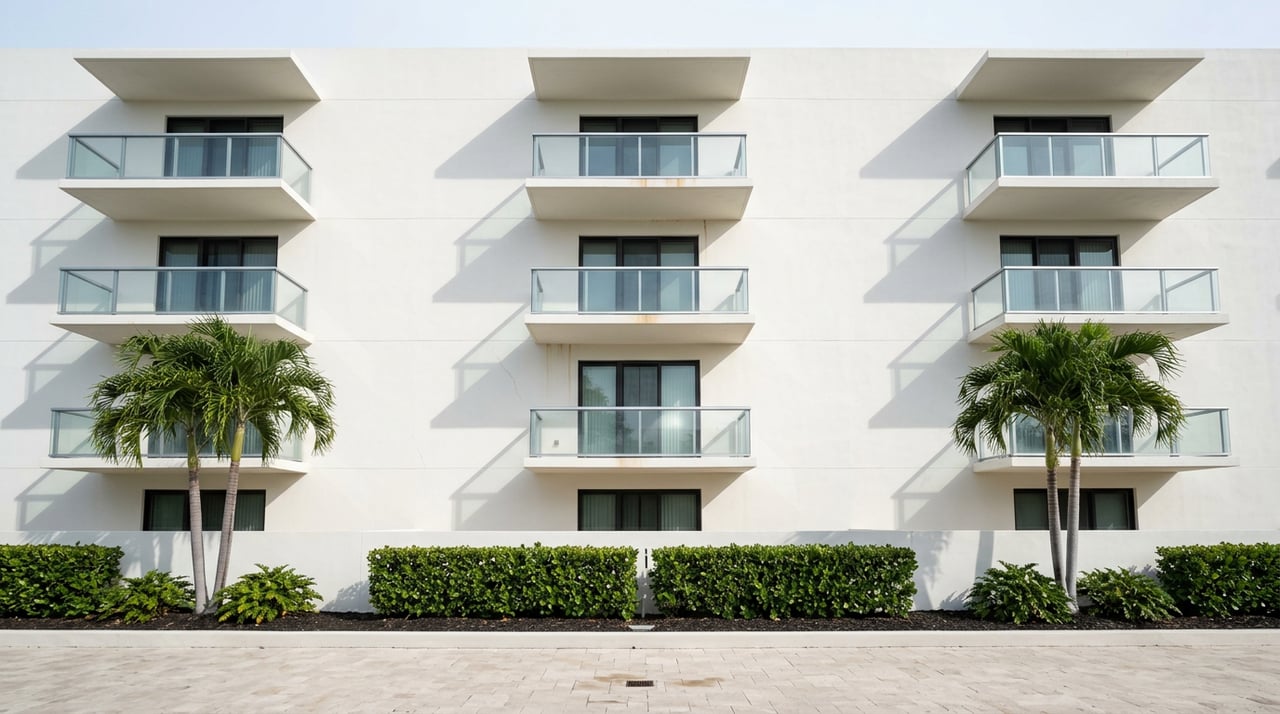
In Fort Lauderdale, the 25-Year Condo Inspection Clock Runs for Every Building, Not Just the Ones on the Water
August 20, 2026
August 20, 2026
A buyer touring a 1998-built mid-rise a few blocks off Sunrise Boulevard once told me the building "still had time" before any structural inspection was required. He'd read that Florida only forces the issue at 25 years for buildings within three miles of the coast, and this one sat comfortably inland. He was reading the state statute correctly. He was reading Fort Lauderdale wrong.
Broward County doesn't use the state's coastal carve-out. Under the Broward County Board of Rules and Appeals Policy 05-05, every building three stories or taller in the county comes due for a Building Safety Inspection at 25 years of age, then every 10 years after that, regardless of how far it sits from the water. The City of Fort Lauderdale administers this locally through its Building Services Division, which sends the notice and starts a 180-day clock for the inspection and report. That inland condo my buyer liked wasn't years away from anything. It was already inside the window.
This matters more in 2026 than it did a year ago, because the paperwork that used to feel like a background detail now determines whether a mortgage closes and what a buyer pays for the next decade.
Florida's statewide milestone inspection statute, Section 553.899, sets the trigger at 30 years for most buildings, or 25 years if the building sits within three miles of the coast and the local jurisdiction says so. That's the version most national condo guides repeat, because it's the version written into state law.
Broward's own inspection program actually predates Surfside by more than a decade. The county has run structural and electrical recertification since 2006, originally on a 40-year cycle modeled after a Miami-Dade program that goes back to the 1970s. After Surfside forced the state to rewrite the rules in 2022, Broward didn't stop at adopting the new 25-year-near-coast standard. Its Building Safety Inspection Program, updated in 2024, extended the 25-year trigger to every qualifying building in the county, coastal or not. A buyer comparing a Fort Lauderdale condo to one in a county that only follows the state's coastal carve-out will consistently underestimate how soon the building in front of them faces a structural review.
| State default (FS 553.899) | Broward County (BORA Policy 05-05) | |
|---|---|---|
| First inspection trigger | 30 years, or 25 if within 3 miles of coast | 25 years, regardless of distance from coast |
| Applies to | Condos and co-ops 3+ habitable stories | All qualifying buildings 3+ stories countywide |
| Administered by | Local enforcement agency per state law | City building departments (Fort Lauderdale's Building Services Division for buildings within city limits) |
| Repeat interval | Every 10 years after | Every 10 years after |
The distinction isn't academic. A building's age relative to this trigger is often the single fact that tells you whether a special assessment is a live possibility during your ownership or a problem for the next buyer.
Separate from the inspection is the Structural Integrity Reserve Study, or SIRS, required under Florida Statute 718.112(2)(g) for any residential condo or co-op building three or more habitable stories, on a 10-year cycle from the building's creation date, regardless of age. The SIRS is the financial half of the equation: it prices out eight structural components (roof, load-bearing structure, fire protection, plumbing, electrical, waterproofing, windows and exterior doors, and a catch-all category for any other item over $25,675 in 2026 that affects those systems) and sets a funding schedule.
The deadline for completing an initial SIRS passed December 31, 2025. The part that changes the math for a 2026 buyer is what happened after that deadline: as of January 1, 2026, associations can no longer waive or reduce reserve funding for those eight components by owner vote. That option existed for decades and kept monthly dues artificially low in a lot of older Broward buildings. It's gone now for anything the SIRS identifies as structural.
If a building's SIRS shows a large funding gap, that gap has to close through regular contributions, a loan, a line of credit, or a special assessment. There's no fifth option anymore.
Two changes from the past year shift real risk onto the buyer's side of the table, and both are easy to miss if you're relying on a listing sheet.
First, the rescission window on a resale condo purchase in Florida has been extended, giving buyers more time to review association documents and back out before the deal is final than the older three-day standard allowed. Use that window. It exists specifically so you can read what you're buying into before you're locked in.
Second, the responsibility for reviewing board meeting minutes has moved. It used to fall more heavily on sellers to flag any assessment that had been discussed, even informally, at a board meeting. Increasingly, the expectation is that buyers request and read the last 12 months of minutes themselves, and if an assessment surfaces later that was sitting in those minutes the whole time, there may be no recourse against the seller for failing to mention it. A South Florida condo buyer named Laura Bustamante described exactly this kind of surprise to WSVN's Help Me Howard team this year, facing a payment plan she said would total $53,800 over 13 years starting in May 2026. Attorney Howard Finkelstein's advice on that segment was blunt: verify what's already been imposed and what's coming, and consider a lawyer, because the terminology in these documents is not written for a first-time reader.
Before you write an offer on a Fort Lauderdale condo in 2026, ask the seller or listing agent for:
The financing consequence is the one that catches buyers off guard fastest. A building that hasn't completed its SIRS or milestone inspection, or that shows a severe funding shortfall, can end up on Fannie Mae's unavailable list. That blocks conventional mortgage financing outright, which narrows the buyer pool for that unit to cash buyers and shrinks what a seller can realistically ask.
The dollar stakes elsewhere in South Florida show why lenders are cautious. Owners at The Cricket Club in North Miami faced assessments as high as $134,000 per unit in 2024. At Mediterranean Village in Aventura, some owners were assessed up to $400,000. Neither of those buildings is in Fort Lauderdale, and I'm not suggesting either figure applies here. What they show is the range of outcomes when a building deferred structural maintenance for years and then had to fund the fix all at once. That's the scenario the current law is built to prevent going forward, and it's exactly why a building's compliance status is worth more attention than its finishes.
It's tempting to assume this is only a resale-building problem. It isn't. A recent Fort Lauderdale-focused buyer's diligence guide walks through the same document review for properties like Regis® Residences Bahia Mar Fort Lauderdale, Four Seasons Hotel & Private Residences Fort Lauderdale, and Riva Residenze Fort Lauderdale, new-construction buildings where the questions shift to projected budgets, warranty terms, and the timing of when the developer hands financial control to the owners. Neither resale nor new construction is automatically the simpler purchase. Both require reading the same categories of document through a slightly different lens.
Does this apply to single-family homes? No. SIRS and the milestone/Building Safety Inspection rules apply to condominium and cooperative buildings three or more habitable stories. Single-family homes, duplexes, and most townhomes fall outside this framework entirely.
If a building already passed its 25-year inspection, is it in the clear? Only until the next 10-year cycle. Passing doesn't remove the requirement to inspect again, and it doesn't tell you whether the SIRS funding behind that building is adequate.
Can I still buy in a building that hasn't completed its SIRS? You can, but treat incomplete compliance as a reason to slow down, not a technicality. Ask why it's late, request whatever documentation does exist, and confirm financing eligibility before you're past your rescission window.
The building's age relative to Broward's 25-year clock, and what its SIRS says about funding, will tell you more about your real cost of ownership than the listing photos ever will. If you're weighing a Fort Lauderdale condo purchase and want a second set of eyes on the documents before you're locked into a contract, Matthew Heinz can help you read the building's paperwork the way a buyer should, before you fall in love with the view.
Stay up to date on the latest real estate trends.

Get assistance in determining current property value, crafting a competitive offer, writing and negotiating a contract, and much more. Contact him today.